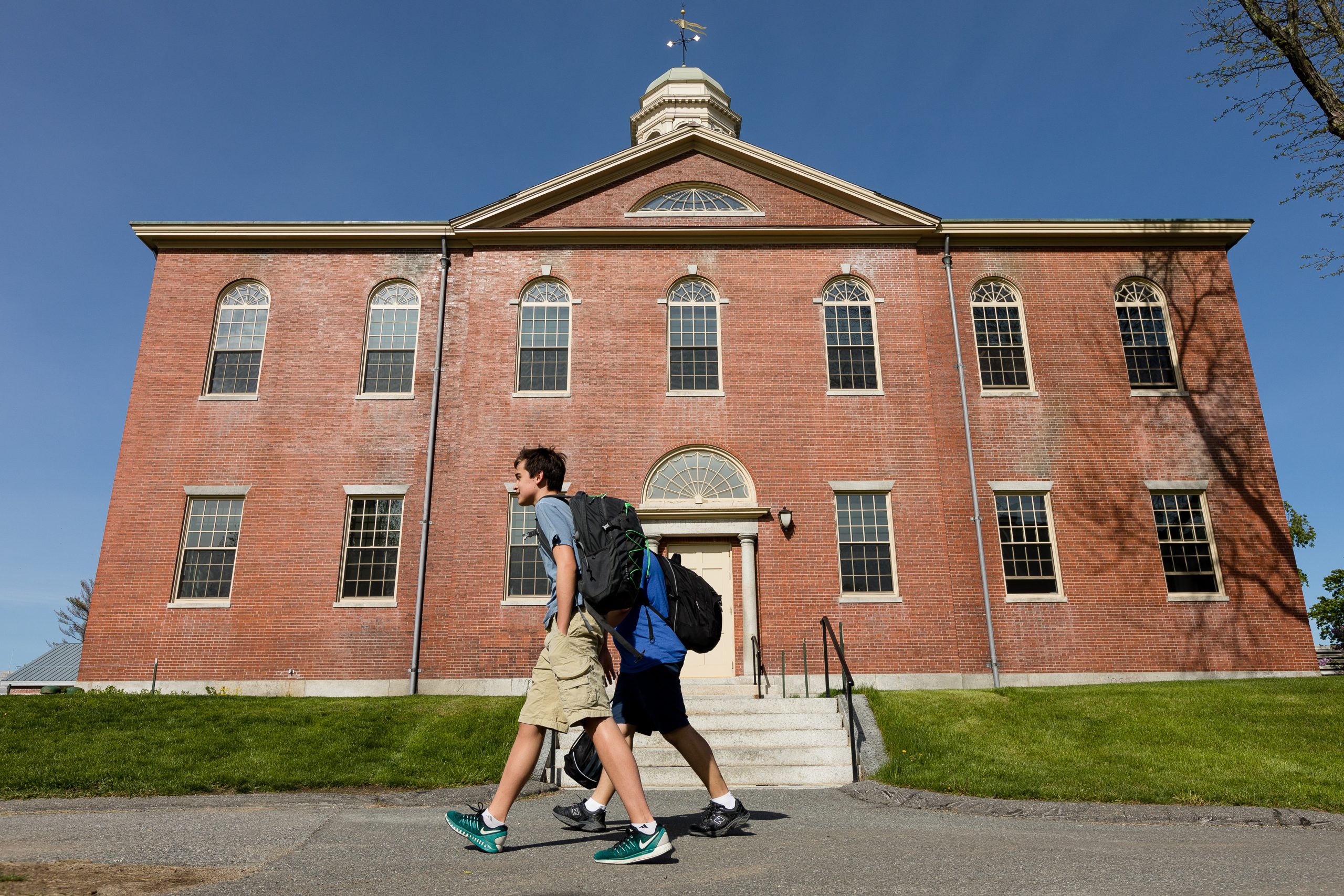
Excerpted from Memoirs: William Douglas Fisher. My Life so Far. . . (313 pp. illustrated, 2023)
On getting adjusted. . .
“New England was absolutely nothing like Arizona or Nebraska. The first thing I noticed was everyone wore tweeds and khaki’s instead of blue jeans and T-shirts. . . . The wine-red corduroy jacket and bright blue gabardine slacks [Mom] bought me looked nothing like what I encountered at Andover. I felt very self-conscious, and it took me a couple of months to convince my folks to pay for a tweed jacket and khakis. . . . Sherwood K. (Woody) Freeman . . . was from the San Francisco Bay area. . . bright, droll, amusing, and very unconventional. He dressed in the Bay area ‘cool’ clothing styles, not East Coast tweedy, and looked very much out of place. . . . He said he felt like he was on another planet at Andover. . . and didn’t return for his senior year.”
“I met Fred Pownall from Milford, Connecticut who lived at the opposite end of my dorm. Our acquaintanceship developed into a life-long friendship during our two years at Andover, four years at Princeton and two years in the military in Washington, D.C. . . . I will never forget one of our first conversations when Fred asked me where I lived. When I said Omaha, Nebraska he had a shocked look on his face and asked where the hell is that? As I tried to describe the location, he admitted his knowledge of U.S. geography ended at the Hudson River in New York and resumed at San Francisco in California. In his mind, everything in between was just open plains and Indian villages.”
On pranks large and small . . .
“One major prank engineered by a boy in our dorm named Dave Moore has become a classic in Andover school history. . . . It involved a fair number of students and required a number of steps to pull it off. The main north-south highway was blocked off and all the vehicles (cars, trucks, buses, etc.) going north were rerouted east through all the main campus buildings, past faculty housing and classrooms, before being redirected back onto the highway. Traffic traveling south was all rerouted into the West Quad, past faculty homes, past six large dormitories, and down a long, winding dead-end road called Hidden Field Road. The dead-end created an enormous back up. We watched with glee from our windows as the traffic problem grew worse and worse. It was dark, headlights were on, horns were blaring, and people were trying to back up or turn around but there was no room for that. The traffic just kept coming until some smart truck drivers figured out that they had to move the detour signs to let traffic flow south again. Even then it took several hours for all the trucks and cars down the dead-end lane to back out.
“The perpetrators were never identified or caught. They had repurposed local highway construction signs and A-frame barricades to create the detours and roadblocks quickly and managed to do it all after 8:00 PM when the campus was virtually empty except for a few people returning to their dorms from the library. Because so many people crossed the campus from the library during the time it took to put everything in place, it was impossible to identify the culprits. We laughed our heads off for hours watching it all develop and unwind. Pranking was an artform in the ‘olden’ days.”
[For another account see 1955 class note by Steve Clarkson in the Spring 2026 issue of Andover Magazine, p. 46. Lightly edited and reproduced on this website under the title “Down a Road Named Hidden Field: THE Story of the Great Route 28 Detour Caper?” https://davidclarkharrison.com/2025/10/06/down-a-road-named-hidden-field/.]
“The old fire escapes consisted of coils of long fire ropes that hung next to our windows on hooks. The ropes had a sling to slide over your head and under your arms to lower yourself to the ground. . . . The fire rope . . . enabled a couple of classmates to empty all the furniture out of a 3rd floor [Taylor Hall] dorm room used by a student nicknamed ‘TODO’ (pronounced TOE DOE) short for his full name, Tony Doherty. When TODO came back from the library one night, he found his door upside down on its hinges and his third-floor room entirely empty. All he could find inside was his fire rope trailing out the window. Pranksters had tied all his furniture (desk, chair, dresser, and bed) to the rope using his neckties, towels, and underwear and then pushed it all out the window.
“We huddled inside our rooms waiting to see what would happen. All hell broke loose when the Housemaster looked outside his downstairs window and saw TODO’s furniture. He never was able to determine who among his 20 charges was responsible, but we all had to help restore TODO’s room. I felt too new to initiate my own pranks, but I was a willing, helpful observer and kept my mouth shut.”
“Senor Merriam, my Spanish instructor was another real character. . . . I recall Merriam accidentally throwing his shoe through an open second story window while trying to gain the attention of one of the students who was distracted. Everyone got a great laugh out of it, including him. The boy who was the target for his shoe was sent downstairs to fetch it. Even funnier, the target student was Les Blank, the center on our football team, a big man with a great sense of humor. To taunt Senor Merriam, Les wore a necktie to class that hung down from his collar to the floor. It satisfied the tie requirement and everyone got a great kick out of it.”
On girls. . .
“Andover was an all-male school in those years so activities with the opposite sex usually occurred at home while on vacation. The school did organize a few ‘tea dances’ with nearby girls’ schools but they were formal and closely watched. There was a well-known Burlesque Theater called the ‘Old Howard’ near the railroad station in Boston where students with time to kill between trains often spent an hour or two. The social environment at school was constrained and we were encouraged to work out excess energy in sports and studies, not always easy to do.”
“One time I thought I discovered a new path to social engagement by joining the Glee Club. The group traveled to girls’ schools to serenade the young ladies. My only stage career prior to that had been dancing the ‘Can-Can’ in a wild costumed dance line on stage in Tucson. Here I joined 39 young men and spent six weeks learning to sing together. I sang first base because by then my voice had changed. The Glee Club director [Willie Schneider] listened carefully as we polished our production for the road. Something bothered him and he decided to listen to each boy sing his part individually. All 39 of us had our turn. After listening to us sing he decided to perform it without my voice, and it came together perfectly. I was deeply disappointed because we were only a week from our first performance at Dana Hall in Wellesley and I had worked hard to learn all the songs. [“If I Loved You,” Rodgers & Hammerstein (Carousel, May 1945) performed at Dana Hall.] My disappointment came not so much because I loved singing but because I wouldn’t be able to travel and meet young girls. Anyone who has ever heard me sing in person understands the Glee Club director’s decision, especially my children.”
“When the cold weather came, I decided to learn an outdoor winter sport and chose ice skating. I volunteered and worked as one of the assistant managers on the varsity ice hockey team. . . . Our hockey team manager, Walton J. McLeod, III, . . . didn’t know how to ice skate and we learned the hard way. Walt became a close friend in 1954 and that close friendship has continued more than 65 years. He went to Yale, then law school becoming an attorney and politician in South Carolina where I met his family and toured the state meeting relatives and friends. He fixed me up with a date, the lovely ‘Miss Chesterfield County’ in Cheraw, SC and introduced me to a nurse in Waterboro whose mission was to bring young men into manhood. Later Walt had the chance to meet my family. We’ve always had a lot of fun. Until recently, we saw one another annually, either in South Carolina or Florida.”
“Eighteen years after I graduated in 1955, Andover became coeducational (in 1973). I’ve always felt a bit envious of the students since then.”
On the joys of drinking. . .
“The travel from Omaha and Andover usually involved a long, tiring two-day passenger train ride. . . . [T]he second leg was from Chicago to New York (aboard the well-known 20th Century Limited). . . the best part. It was an Express passenger train with amenities and because the drinking age in New York State was 18, I was able to buy beer and drinks when the train passed through the state. My schoolmates aboard the train would try to buy enough ‘inventory’ in New York to last the rest of the trip.”
“Another friend was Hewitt Brown, a very funny man from Louisville, Kentucky. We were both cigarette smoking pool players and shared many laughs. Once we rode the train together going home at the end of the school year. The trained stopped in Louisville on its way to Chicago and I was invited to stay over with him for a weekend. Hewitt had an older brother at Yale and his father was an insurance man and active in the local country club. One night we dressed up and went there for an annual ‘Kentucky Derby’ social event. Although the drinking age was 21, and we were still teenagers, we had free access to everything being served. We used his family membership number to charge food and some drinks. Hewitt didn’t want his parents to know about the liquor we drank so he ordered drinks using a fictitious name and fake club membership number. It worked like a charm and his older brother covered for us when we got drunk. I know we had a wonderful time but don’t recall much about it. We always wondered if anyone was ever billed.”
“After my graduation in 1955, I returned to Omaha for the summer and operated the Class VI liquor store on the [Offutt] Air Force base. This was a really busy but fun summer job. What a great graduation gift!”
On playing too much pool. . .
“During my second trimester, I became more engaged in the social aspects of school. I started hanging around with some guys just talking and smoking cigarettes outside our dining hall. I played pool more than I studied and became 2nd best pool shark in our class, just behind Tony Roosevelt, a brilliant student who left Andover for college in 11th grade and finished Medical School in record time. That was not the case with me. My academic rank tumbled down to 210 out of 215 students. The dean of the school wrote to Dad saying ‘Doug has given a lot to Andover during his first two terms here, but he hasn’t let Andover give him much. If he doesn’t improve his performance substantially in the final term this year, he will not be invited back for his senior year.’
“The jig was up! Dad reminded me I was now 16 years old, and at 17 years old I would be old enough to enlist in the Army as a private and he assured me I had parental permission to do so. . . . I got back to work and managed to survive that year, returned to finish my senior year, and was accepted into Princeton. . . . I still played pool occasionally, but not much. Some friendships from my senior year have extended for many years, including one with Art Hotchkiss, a very good athlete who became a successful dentist and oral surgeon. We, along with a few other aging classmates, still try to golf together once each summer at Bald Peak in New Hampshire
On what Andover meant. . .
“My two years of education at Phillips Academy completely changed the direction of my life. It showed me possibilities and opened doors for me I never knew existed. It was the best ‘gift’ my parents ever gave me, along with their unending love.”